
Groundbreaking – a celebration of life. become a follower
Category Archives: Construction
Groundbreaking – a celebration of life
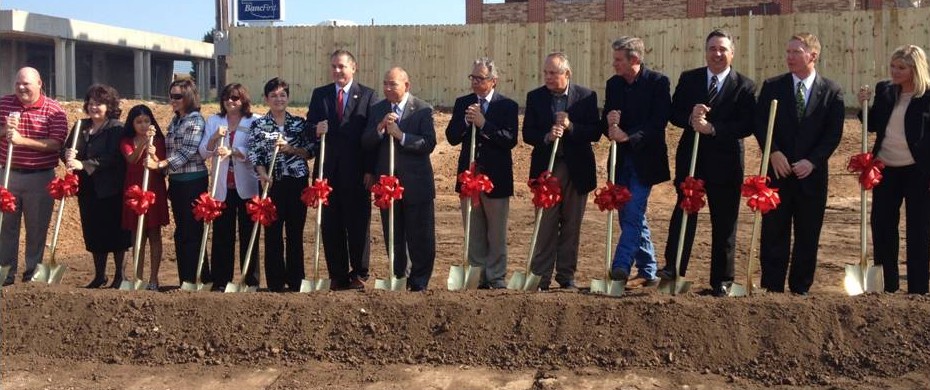
Groundbreaking is the celebration of new life. It’s the celebration of a new beginning; the beginning of a new project and the beginning of breathing life into a building with the start of construction. Groundbreaking is a traditional ceremony around the globe signifying the beginning of construction. Although the “ceremonial groundbreaking” may actually take place some time prior to the beginning of construction it is a ceremony that allows the owner to celebrate the beginning of a new project with friends, dignitaries, businessmen and special guests. Continue reading
Filed under Construction, Guests
The Road Ahead – and then some

The Path of Construction
The project has come a long way, but there is plenty of road ahead to navigate. FSB has guided the project from its inception to the current location in the project timeline. We have traveled together from project definition (programming), schematic design (preliminary design) and design development (final design) through construction documents (construction drawings and specifications). FSB, the Chickasaw Nation (owner) and Flintco (contractor) are currently working together to assemble and test the price of construction.
The road ahead is filled with construction activity, but not all of it involves physical activities at the job site like moving dirt, pouring concrete and setting steel. The early months of construction are busy with organizing the project so that all of the physical activities can move forward as smoothly as possible.
The contractor has responsibility for a number of these early management and organizational activities. These include:
Preparing a list of all subcontractors and suppliers; this list is submitted to the Architect and Owner for their review and approval. The Owner may request the replacement of a subcontractor and there is a process for evaluating the impact if any to the project schedule and cost.
Preparing a construction schedule; this is a breakdown of activities by trades and cost categories from the beginning of the project to project close out at the end of the road. These schedules are typically created in software that is designed to track manpower and costs and is a powerful tool for the contractor in performing their job as well as effectively communicating the schedule to the Architect and Owner.
Preparing a Schedule of Values; this document breaks down the entire cost of the project by trades, labor and materials. This document once approved by the architect becomes the basis for monthly applications for payment and tracks the percentage of completeness of each item in the schedule.
Preparing a Schedule of Submission of Shop Drawings, Product Data and Samples; this document outlines a chronology for when each required shop drawing, product and sample will be submitted to the Architect for review and approval. The timeline of these submissions typically parallels the construction schedule so that the early construction activities are also the initial submissions.
FSB as architect and engineer of the project has the responsibility to review and approve the above submissions and advise the owner of any concerns. The entire process continues to be a team affair with the architect, owner and contractor working closely together to achieve the common goal of the completion of a great project.
Upcoming Events
More Local Beta
There are more interesting places to visit in the vicinity of the Visitor Center.

Getting to Know More Players
Here are some more of the Design Team that I plan to corral for an interview in the near future.
 I’ll keep you posted…
Filed under Construction, Guests
The Newest Team Member – selecting a contractor

There is a point in the life of a project as it moves towards the fruition of being an addition to the built environment that it is ready for construction. This means that another member needs to be added to the overall team whose services include constructing the project. The new team member we are talking about is the contractor. Up to this time it has primarily been the owner and architect working together to define and design the project. Continue reading
Filed under Construction, Design
The Things That Go Bump In The Night

A popular title for the fearful things that can take place during the nighttime. But do you ever worry about your building falling over during the night. I think structural engineers do; it may be their worst nightmare.
So, what holds a building up? What gives the building a sound and solid footing on mother earth? Continue reading
Filed under Construction, Design, Materials
Slicing and Dicing

It sounds like a Veg-O-Matic demonstration guy at the state fair at the end of which you’re not sure what all got chopped up. The slicing and dicing of the building, however, is done much more systematically and carefully so you can actually tell what has been cut through.
I know it’s hard to imagine, but the building that is drawn in the computer is a full-scale 3D model of the real thing. Slicing up the building in the computer provides details that are referred to as sections. By slicing through the building in various directions it allows us to see what is going on inside the spaces. That includes the spaces inside the walls, the spaces above the ceiling, the spaces below the floor and more. These views let us see how the pieces and parts of the building go together. When the plans are printed out, they are scaled down and floor plans are usually shown at 1/8”=1’-0”. It would take a lot of paper to print it out full-scale. Continue reading
Filed under Construction, Design, Materials
Blueprints / what are they – what are they good for

Blueprints-what are they
The term “Blueprint” is a common name for printed building plans that actually grew out of the printing/developing process that rendered a large sheet of paper blue resulting with white lines on a blue background. This was replaced by the diazo print process that used ammonia gas as the developing agent and changed the look to blue lines on white background. Young graduates were delegated to running the prints when needed and there are many from that era that surely passed out on occasion from the obnoxious ammonia fumes. We gladly shoved the FSB ammonia printer out one of the upper floor windows years ago when the new technology introduced electrostatic plotters that produce a copier quality product on a large paper format which appears as black lines on white background. Continue reading
Filed under Construction, Design, Materials
The S… That Came In From The Cold

The 1965 film adaptation of the novel by John le Carre with the same title stars the ever charismatic but mysterious Richard Burton. While the film is based on the cold war spy industry and is steeped with figuring out who are the real undercover agents and possible defectors, our story is much simpler but hopefully does not have a tragic ending like the movie.
The S… coming in from the cold in our case is the structure that is continuous from interior to exterior and entails figuring how to limit the baggage it is trying to carry from the outside to the inside. The baggage is the transmission of the exterior cold to the inside conditioned space of the building. In reality the physics of the situation is that heat is being lost at such a rapid rate through the structure to the cold exterior that it lowers the temperature of the inside structure near the perimeter to the point where moisture in the air will condense on the surface and drip down on interior finishes. Bad situation. Continue reading
Filed under Construction, Design, Materials
Design / the continuous thread

Design
When does it begin; when does it end? Design has its beginnings in the early dreams and vision of the client. Formalized design activity comes into play when the design professional engages in the project. These formal stages of preliminary design and final design initialize and refine the big idea respectively. While preliminary design creates the first generation of site and plan organization, final design investigates and resolves how the building components begin to integrate with one another. Final design sets the stage and direction for how the materials will blend and transition throughout the building. The pieces and parts of the architecture and engineering systems come together to form a composition of assemblies. These include floor assemblies, wall assemblies, ceiling assemblies and roof assemblies. However, the design effort does not end with final design. Continue reading
Filed under Construction, Design, Interior, Materials
The Site

The proposed site for the Chickasaw Nation Visitor Center is located in Sulphur, Oklahoma. Sulphur is known as the City of Springs because of the local mineral waters and was initially named Sulphur Springs. Within twelve years of being formed as a township in 1892, the city has a unique history of being moved between three different sites. The population of Sulphur in 2009 was 4900. For you geomappers, the current location of Sulphur is 34˚30’33” N 96˚58’31”W on the globe.
(new post each Tuesday. Check out: The Client, The Gateway Project) Continue reading
Filed under Background, Construction, Design
 .
. .
. Design Matters